Precision in Practice: Advanced Fabrication Techniques That Make PVC Foam Board the Contractor's Material of Choice
Any experienced contractor will tell you that a material's specification sheet only tells part of the story. The other part is told at the job site—in the shop, at the router table, and during the final fit-up when tolerances either hold or they don't. PVC foam board has earned a strong reputation on specification sheets for its moisture resistance, dimensional stability, and chemical inertness. But among the contractors and fabricators who work with it daily, the conversation increasingly centers on something equally important: how well it fabricates.
This guide explores the cutting, routing, laminating, bonding, and finishing techniques that skilled professionals across the United States are using to adapt PVC foam board for demanding industrial applications. It covers best practices, common errors, and the fabrication flexibility that is giving contractors a genuine competitive advantage in specialized project bids.
Understanding the Material Before You Cut It
Effective fabrication begins with understanding how PVC foam board differs from the materials it frequently replaces. Unlike plywood, it has no grain direction to consider. Unlike MDF, it does not produce a dust that requires aggressive respiratory protection under standard cutting conditions. Unlike rigid fiberglass or phenolic panels, it does not require diamond-tipped tooling for routine cuts.
PVC foam board is a closed-cell thermoplastic panel. Its density—typically ranging from 3 lb/ft³ to 9 lb/ft³ depending on grade—determines its machinability, fastener-holding capacity, and surface hardness. Lower-density boards cut with less resistance and are suited for trim, signage, and non-structural applications. Higher-density grades are appropriate for equipment housings, structural panels, and applications where surface hardness and screw retention matter.
One fabricator working in the Gulf Coast industrial corridor put it plainly: "The first time I switched from MDF to PVC foam board on an equipment enclosure project, I expected a learning curve. What I found was that the material was more forgiving, not less. It cuts clean, it doesn't blow out on edges, and you don't have to worry about what happens if a panel gets wet during installation."
Cutting: Saws, Scores, and CNC
For straight cuts in shop or field conditions, standard carbide-tipped circular saw blades perform reliably on PVC foam board. A blade with a high tooth count—60 to 80 teeth for a 10-inch blade—produces the cleanest edge finish and minimizes chipping on panel faces. Feed rate matters: too fast, and the cut edge becomes rough; too slow, and frictional heat can cause slight surface glazing near the cut line.
For field cuts where power tools are impractical, PVC foam board can be scored and snapped along straight lines using a utility knife and straightedge, similar to the technique used with gypsum wallboard—though multiple scoring passes are typically required for panels above ½-inch thickness. This capability is particularly valuable during complex fit-ups in tight mechanical spaces where saw access is limited.
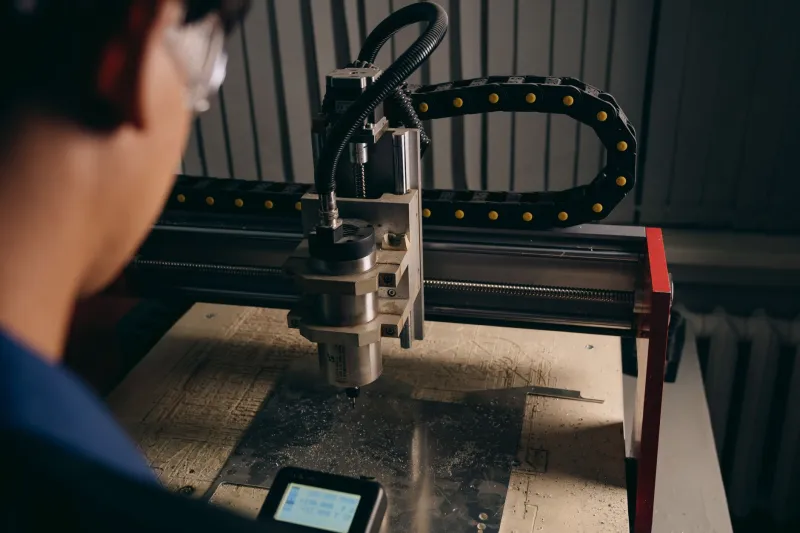
CNC routing is where PVC foam board's fabrication versatility becomes most apparent. The material responds exceptionally well to CNC machining, holding tight dimensional tolerances across complex geometries without the fiber tear-out that limits MDF performance on intricate profiles. Upcut spiral bits work well for through-cuts; downcut spirals produce cleaner face surfaces on partial-depth routing. Compression bits—cutting upward on the bottom face and downward on the top—are the preferred choice when both panel faces must remain chip-free, as in visible architectural elements.
Shop speeds for CNC routing typically range from 18,000 to 24,000 RPM with feed rates between 150 and 300 inches per minute, though these parameters should be dialed in based on specific density grade and bit geometry. Crucially, PVC foam board does not require coolant during machining, and the chips produced are dry, non-hygroscopic, and easy to collect.
Routing Curved Profiles and Complex Geometries
One of the more technically demanding applications for PVC foam board involves curved architectural features—radius wall panels, column wraps, curved equipment housings, and decorative fascia elements that would require custom millwork or fiberglass fabrication in other materials.
For shallow curves, higher-density PVC foam board can be cold-bent to modest radii by applying even pressure across the panel width. The practical minimum bend radius achievable through cold bending depends on panel thickness and density; thinner panels in the 3mm to 6mm range can achieve curves that would crack or splinter wood-based substrates under equivalent force.
For tighter radii, a technique commonly referred to as kerfing—routing a series of parallel relief cuts on the panel's back face—allows the board to conform to curved substrates without fracturing. The spacing and depth of kerf cuts determine the achievable radius; deeper, more closely spaced cuts permit tighter curves. Contractors fabricating curved column wraps for commercial interiors or curved duct housings for HVAC applications have used this technique to produce radius panels that match architectural drawings precisely, without the custom tooling costs associated with fiberglass molding.
A fabricator specializing in cleanroom construction noted: "We've used kerfed PVC foam board for curved wall transitions in pharmaceutical facilities where the radius requirement was tight and the surface had to be smooth enough to meet cleanliness standards. The material holds the curve, accepts the surface coating, and doesn't require the structural backing that fiberglass would need."
Laminating and Bonding: Adhesive Selection and Surface Preparation
PVC foam board's smooth, non-porous surface requires attention during laminating and bonding operations. Standard wood adhesives and water-based contact cements perform poorly on PVC surfaces due to inadequate surface energy for mechanical adhesion. Solvent-based contact cements formulated for plastics, two-part structural adhesives (particularly methacrylate-based formulations), and PVC-compatible construction adhesives are the appropriate choices.
Surface preparation is straightforward but non-negotiable. Panel faces should be clean and free of dust, oil, and mold-release residue. A light scuff with 120-grit sandpaper increases surface area and improves adhesive mechanical grip without damaging the panel face. For high-strength structural bonds, particularly in equipment housing assemblies subject to vibration, a primer formulated for PVC surfaces provides a meaningful improvement in bond durability.
Laminating PVC foam board to metal substrates—aluminum sheet, galvanized steel, or stainless steel facing—is a common requirement in food processing and industrial panel applications. In these assemblies, the adhesive must accommodate the differential thermal expansion between PVC and metal. Flexible adhesive formulations with elongation ratings above 100 percent are preferred over rigid epoxies, which can develop interfacial stress cracks under thermal cycling.
Finishing: Paint, Surface Coatings, and Texture
PVC foam board accepts paint without priming in many applications, though a bonding primer formulated for non-porous plastics improves topcoat adhesion and long-term finish durability. Latex and acrylic paints are compatible; solvent-based enamels perform well on higher-density grades. The panel's smooth factory surface produces a uniform finish with minimal topcoat consumption, a practical advantage in large-area applications.
For industrial environments requiring chemical resistance, two-part epoxy and polyurethane coatings applied to PVC foam board surfaces provide a durable barrier suitable for food processing, chemical handling, and wet industrial environments. The panel's dimensional stability ensures that coatings do not crack or peel due to substrate movement—a failure mode frequently observed on wood-based substrates in the same environments.
Where texture is required—for slip resistance on horizontal surfaces or for aesthetic matching with adjacent materials—PVC foam board can be mechanically textured through routing, embossing, or abrasive finishing, and the resulting surface accepts coating systems consistently.
Avoiding Common Fabrication Errors
The most frequently reported fabrication issues with PVC foam board fall into three categories. First, using inappropriate adhesives—particularly water-based formulations—leads to bond failures that are often attributed to the material rather than the adhesive selection. Second, neglecting thermal expansion in long panel runs causes buckling and joint stress; PVC expands approximately 3.5 times more per degree Fahrenheit than aluminum, and fastener patterns and joint details must account for this. Third, applying excessive heat during fabrication—from friction, improper saw speed, or heat-bending without controlled equipment—can cause localized softening that distorts panel geometry.
None of these are inherent limitations of the material. They are workmanship details that experienced fabricators address through proper technique selection and tool calibration.
Why Fabrication Flexibility Wins Bids
In competitive project bidding, the ability to fabricate complex assemblies in-house—without subcontracting specialty millwork, fiberglass molding, or metal fabrication—is a direct cost advantage. Contractors who have developed PVC foam board fabrication competency consistently report the ability to deliver custom panel assemblies, precision equipment housings, and curved architectural elements at lower cost and faster lead times than alternatives requiring specialized manufacturing.
For US contractors working in construction, industrial maintenance, and specialized facility fit-out, the material's workability is not a secondary benefit. It is a core competitive asset—one that translates directly into project wins and client confidence.