Material Selection as a Production Strategy: How PVC Foam Board's Workability Drives Down Secondary Processing Costs
In manufacturing procurement, the conversation almost always begins with price per sheet. It rarely begins with what happens after the material arrives on the shop floor. That omission is expensive.
For industrial facilities that depend on secondary processing—cutting to tolerance, routing complex profiles, finishing edges for assembly or aesthetic compliance—the material itself is a production variable. Choose the wrong one, and every downstream operation absorbs the cost. Choose correctly, and secondary processing becomes a source of efficiency rather than friction.
PVC foam board occupies an increasingly prominent position in this calculus. Its cellular structure and consistent density distribution give it machining characteristics that rigid alternatives—aluminum composite panels, high-density polyethylene sheet, fiber-reinforced composites—struggle to replicate at comparable cost. For procurement and operations professionals evaluating total production economics, understanding exactly where those advantages materialize is essential.
The Hidden Labor Equation in Secondary Processing
Machining a rigid or brittle panel material is rarely as straightforward as the spec sheet implies. Aluminum composite, for instance, requires carbide tooling, controlled feed rates, and dedicated chip management to avoid delamination at cut edges. Fiber-reinforced panels generate abrasive dust that accelerates bit wear and creates occupational health compliance obligations. Even high-density polyethylene, while chemically inert, can deflect under router pressure without adequate fixturing—adding setup time per part.
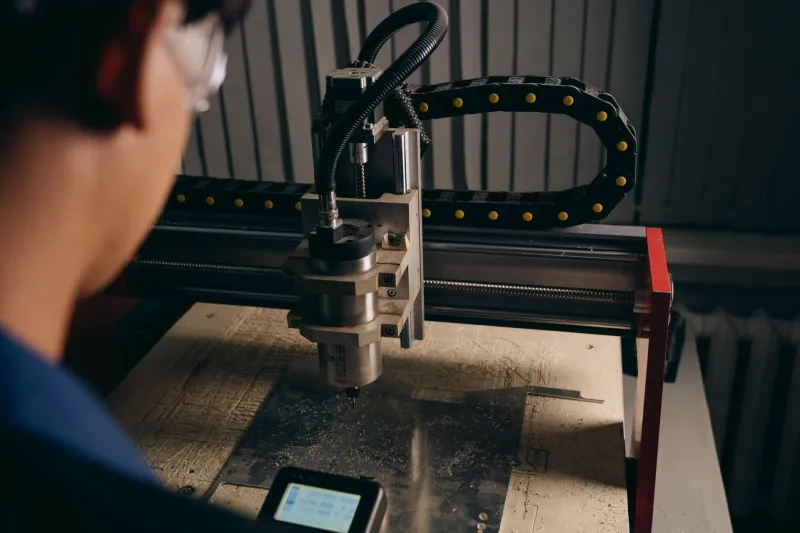
PVC foam board processes differently. Its closed-cell structure responds predictably to standard woodworking and plastics tooling. Circular saw blades, CNC routers, and handheld jigsaws all produce clean, consistent results without the specialized setup requirements that harder materials demand. For facilities running high-volume production, this translates directly into reduced operator time per part—a figure that compounds across thousands of cuts per year.
One Midwest fabrication shop producing custom display fixtures and industrial enclosures documented the difference after switching from aluminum composite panel to PVC foam board for a recurring product line. Secondary processing time per unit dropped by approximately 22 percent. The reduction came not from a single dramatic change but from the accumulation of smaller efficiencies: fewer tool changes, reduced fixturing complexity, and the elimination of a deburring step that aluminum composite consistently required.
Tooling Wear and the Cost of Abrasive Materials
Tooling expenditure is one of the more underreported line items in manufacturing cost accounting. It tends to be absorbed into overhead rather than allocated to specific materials—which means the true machining cost of an abrasive or tool-aggressive substrate rarely surfaces in post-project analysis.
Fiber-reinforced composites and mineral-filled panels are particularly problematic in this regard. Their filler content creates an abrasive cutting environment that degrades carbide edges at an accelerated rate. In high-volume operations, this translates to more frequent bit replacements, increased machine downtime during tooling changes, and higher per-part tooling costs that accumulate invisibly.
PVC foam board's composition does not present this problem. The material is non-abrasive to standard tooling under normal operating conditions. Router bits and saw blades maintain their edge geometry longer, reducing replacement frequency and the associated downtime. For a facility running three CNC routers on a two-shift production schedule, the tooling savings from switching to a non-abrasive substrate can reach several thousand dollars annually—before accounting for the labor saved during tool change intervals.
Edge Quality and the Cost of Rework
Edge condition is a frequent source of rework in fabrication operations. Chipped, torn, or delaminated edges on rigid panels require secondary attention—hand sanding, epoxy filling, or in some cases, part rejection. Each of those outcomes represents cost that did not appear in the original material estimate.
PVC foam board produces smooth, closed edges when cut with appropriate tooling. The material does not chip or delaminate in the manner characteristic of composite panels or particleboard-core products. Routed profiles retain their geometry without the fraying or fiber pull-out common in reinforced substrates. For applications where edge appearance is a compliance or quality requirement—food-grade environments, clean-room installations, customer-facing assemblies—this characteristic eliminates an entire rework category.
A packaging equipment manufacturer in the Southeast reported that after transitioning to PVC foam board for interior panel components, their edge-rework rate dropped to near zero on that product line. Previously, aluminum composite panels had generated a rework rate of roughly eight percent due to edge chipping during router operations. The labor recovered from eliminating that rework more than offset the modest price premium of the PVC foam board specification.
Throughput Bottlenecks and the Value of Predictable Processing
In lean manufacturing environments, bottlenecks are the primary constraint on output. A material that requires longer setup times, more frequent tool changes, or additional quality inspection steps at the machining stage creates a bottleneck that cascades through the production schedule.
PVC foam board's processing predictability is an underappreciated throughput asset. Because the material behaves consistently across sheets and across operators, setup parameters established during initial production runs remain valid for subsequent batches. There is no need to recalibrate for density variation or adjust feed rates to accommodate inconsistent core composition—problems that can affect lower-grade composite panels and natural-fiber substrates.
This predictability also reduces the skill premium required at the machining stage. Operators with standard woodworking or plastics fabrication experience can achieve quality results with PVC foam board without the specialized training that some rigid alternatives demand. In a labor market where skilled CNC operators remain difficult to recruit and retain, reducing the skill threshold for secondary processing has real workforce planning value.
Where Manufacturers Recover the Most Value
Not every application will yield identical savings. The economic return from PVC foam board's machinability is highest in operations characterized by one or more of the following conditions: high part volumes with frequent secondary processing steps, tight edge-quality tolerances that generate rework under current materials, multi-shift CNC operations where tooling wear is a significant cost driver, or production lines where setup time per job represents a meaningful share of total cycle time.
For facilities currently using aluminum composite, fiber-reinforced panels, or low-grade foam substrates in these contexts, a structured comparison—tracking labor hours, tooling consumption, and rework rates across a defined production run—will typically surface the economic case within a single project cycle.
Procurement decisions made on material price alone leave the secondary processing cost structure invisible. For industrial manufacturers operating under margin pressure, that invisibility is no longer affordable. PVC foam board's machinability is not a secondary specification attribute. It is a production economics argument—and one that holds up under rigorous analysis.