Fastener Compatibility in Focus: Engineering Against Galvanic Degradation When Assembling PVC Foam Board Systems
The Hidden Risk in Every Assembly Decision
When industrial professionals specify PVC foam board for construction panels, equipment enclosures, or interior wall systems, the material selection conversation typically centers on density, thickness, and surface finish. What receives far less attention—yet carries significant consequences—is the hardware used to fasten, frame, and secure the board within its assembly.
Galvanic corrosion is an electrochemical process that occurs when two dissimilar metals come into electrical contact in the presence of an electrolyte, such as moisture. The more noble metal in the pairing remains intact while the less noble metal corrodes at an accelerated rate. Though PVC foam board itself is non-metallic and immune to galvanic reactions, the fasteners, brackets, and embedded hardware used alongside it are not. In corrosive industrial environments—coastal manufacturing facilities, chemical processing plants, food production operations, and outdoor structural applications across the US—an uninformed fastener choice can lead to premature joint failure, panel loosening, and costly remediation.
Understanding the mechanics of this problem is the first step toward eliminating it.
How Galvanic Corrosion Develops in Assembled Systems
The galvanic series ranks metals and alloys by their electrochemical potential. When two metals from different positions on this scale are joined in a conductive environment, current flows between them. The anodic metal—the one lower on the nobility scale—gives up electrons and corrodes. The rate of degradation depends on three variables: the electrochemical gap between the two metals, the surface area ratio of the anode to the cathode, and the conductivity of the electrolyte present.
In a practical assembly context, this means that a carbon steel screw driven into an aluminum channel mounted to a PVC foam board panel, exposed to coastal humidity or industrial wash-down cycles, will corrode far more rapidly than either material would in isolation. The aluminum, being more noble than the steel, acts as the cathode. The steel screw—with a relatively small surface area compared to the aluminum channel—corrodes aggressively because the unfavorable area ratio concentrates the electrochemical attack.
PVC foam board does not accelerate or participate in this reaction. However, because it is frequently used as a substrate or panel face in assemblies that include metal framing, anchor bolts, or surface-mounted hardware, the board sits at the center of a system where galvanic compatibility must be deliberately engineered.
Fastener Materials That Introduce Risk
Not all metal fasteners present equal hazards. The following categories warrant particular scrutiny:
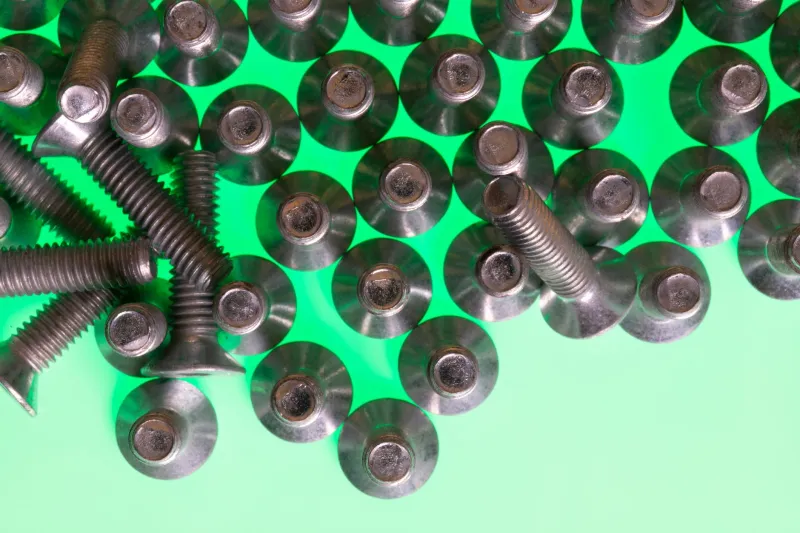
Carbon Steel and Zinc-Plated Steel: Standard zinc-plated or galvanized steel fasteners are widely used in interior construction, but they are poorly suited for corrosive environments. Zinc coatings provide temporary sacrificial protection, but once the coating is breached—through installation torque, vibration, or surface wear—the underlying steel corrodes rapidly. In humid or chemically active industrial settings, zinc-plated fasteners can fail within months.
Copper and Brass: These metals sit high on the galvanic series and will accelerate corrosion in any adjacent less-noble metal they contact. Copper fasteners should never be paired with aluminum framing or galvanized steel components in the same assembly. Despite their corrosion resistance in isolation, their galvanic aggression toward other metals makes them a liability in mixed-hardware systems.
Aluminum Fasteners with Steel Framing: While aluminum offers excellent corrosion resistance on its own, pairing aluminum fasteners with carbon steel framing reverses the problem—the aluminum becomes the anode and corrodes preferentially. This combination is particularly problematic in marine and coastal manufacturing environments common along the US Gulf Coast and Atlantic seaboard.
Fastener Materials That Perform Reliably
Several fastener materials have demonstrated consistent performance in PVC foam board assemblies across demanding industrial applications:
316-Grade Stainless Steel: The preferred choice for corrosive environments, 316 stainless steel contains molybdenum, which dramatically improves resistance to chloride-induced pitting—a critical property in coastal facilities and chemical processing plants. When paired with stainless steel framing or isolated from dissimilar metals through non-conductive barriers, 316 fasteners offer long-term reliability with minimal maintenance requirements.
Monel Alloys: Used in highly aggressive chemical environments, Monel fasteners offer superior resistance to both corrosion and galvanic coupling. Their cost is higher than stainless steel, but in critical applications—such as fastening PVC foam board panels within chemical storage rooms or marine structures—the investment is justified by extended service life.
Nylon and Engineered Polymer Fasteners: For non-structural applications where load requirements permit, non-metallic fasteners eliminate galvanic risk entirely. High-strength nylon screws and anchors are increasingly specified in food processing facilities, pharmaceutical environments, and clean rooms where both corrosion and metal contamination are unacceptable outcomes.
Coated Stainless Steel: In applications where cost constraints preclude solid 316 stainless, epoxy-coated or PTFE-coated fasteners provide an intermediate solution. The coating interrupts the electrical contact necessary for galvanic current to flow, though this protection depends entirely on coating integrity throughout the assembly's service life.
Isolation and Insulation: Engineering the Assembly Detail
Fastener material selection is necessary but not always sufficient. In assemblies where dissimilar metals cannot be avoided—due to cost, availability, or structural requirements—physical isolation of the metals from one another eliminates galvanic risk regardless of material pairings.
Non-conductive gaskets, neoprene washers, and isolating sleeves are standard tools in corrosion engineering. When a steel bolt must pass through an aluminum plate adjacent to a PVC foam board panel, a nylon sleeve around the bolt shank and a neoprene washer under the bolt head prevent the electrical contact that drives galvanic current. These details cost little at the specification stage and prevent expensive failures in the field.
Sealants applied at penetration points serve a dual purpose: they block moisture ingress—the electrolyte that enables galvanic reactions—and they cushion the fastener against vibration-induced wear that can breach protective coatings. Polyurethane and silicone sealants are commonly used for this purpose in PVC foam board assemblies.
Specification Practices That Prevent Field Failures
For procurement managers, project engineers, and contractors specifying PVC foam board systems, the following practices represent a sound baseline approach:
- Define the environment first. Coastal, chemical, food-grade, and standard interior environments each have different corrosion thresholds. Fastener specifications should be derived from environment classification, not assumed from past projects.
- Specify fasteners and framing as a system. Evaluate galvanic compatibility between every metal component in the assembly, not just the fastener in isolation.
- Require documentation. Fastener suppliers should provide material certifications confirming alloy composition. A screw labeled "stainless" may be 304 rather than 316 grade—a meaningful difference in chloride-rich environments.
- Include isolation details in drawings. Non-conductive washers, sleeves, and sealant applications should appear explicitly in construction documents rather than being left to field judgment.
- Conduct periodic inspection in high-risk installations. Even well-specified assemblies benefit from scheduled review, particularly in the first year of service when installation defects are most likely to manifest.
Intelligent Assembly Design Is a Professional Obligation
PVC foam board is a material that rewards careful system thinking. Its resistance to moisture, chemicals, and biological degradation makes it an outstanding substrate for demanding industrial environments. But that durability is only fully realized when the hardware used to secure it is selected with equal rigor.
Galvanic corrosion does not announce itself. It develops slowly, out of sight, until a fastener shears under load or a panel works loose from its framing. The professionals who prevent these failures are those who treat assembly design as a discipline—not an afterthought. Specifying PVC foam board without specifying compatible hardware is an incomplete decision, and the gap between the two is where field failures are born.